America is building factories again. The buildings are ahead of the software.
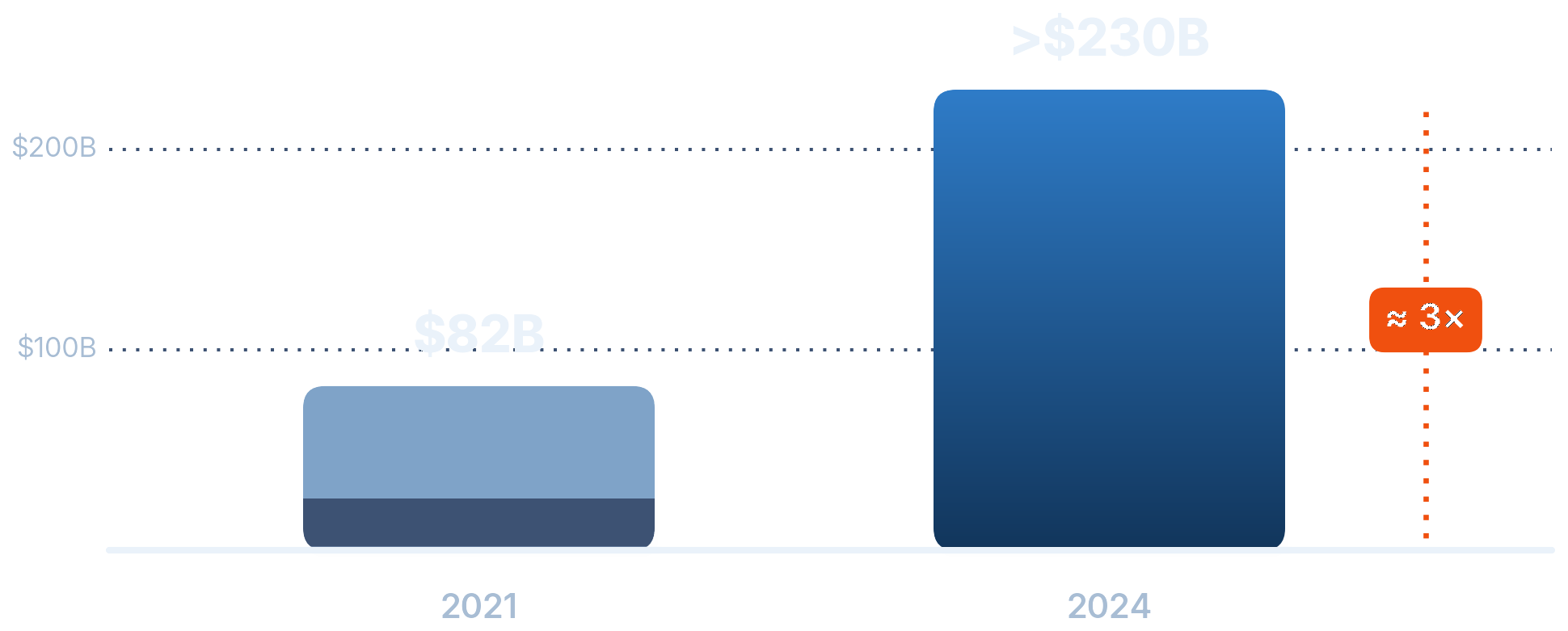
Annual spending on manufacturing construction ran about $82 billion in 2021. By 2024 it was running above $230 billion a year — nearly triple.1 TSMC alone committed $165 billion to American chipmaking, then raised it to $265 billion in July 2026: the largest single foreign direct investment in U.S. history.2
The United States is deploying 2020s capital into buildings and machinery while running them on software whose core ideas predate the web browser. That mismatch — more than tariffs, wages, or robotics — will determine whether the revival delivers.
U.S. manufacturing construction — annual rate1
TSMC’s committed U.S. investment, per TSMC’s own releases2
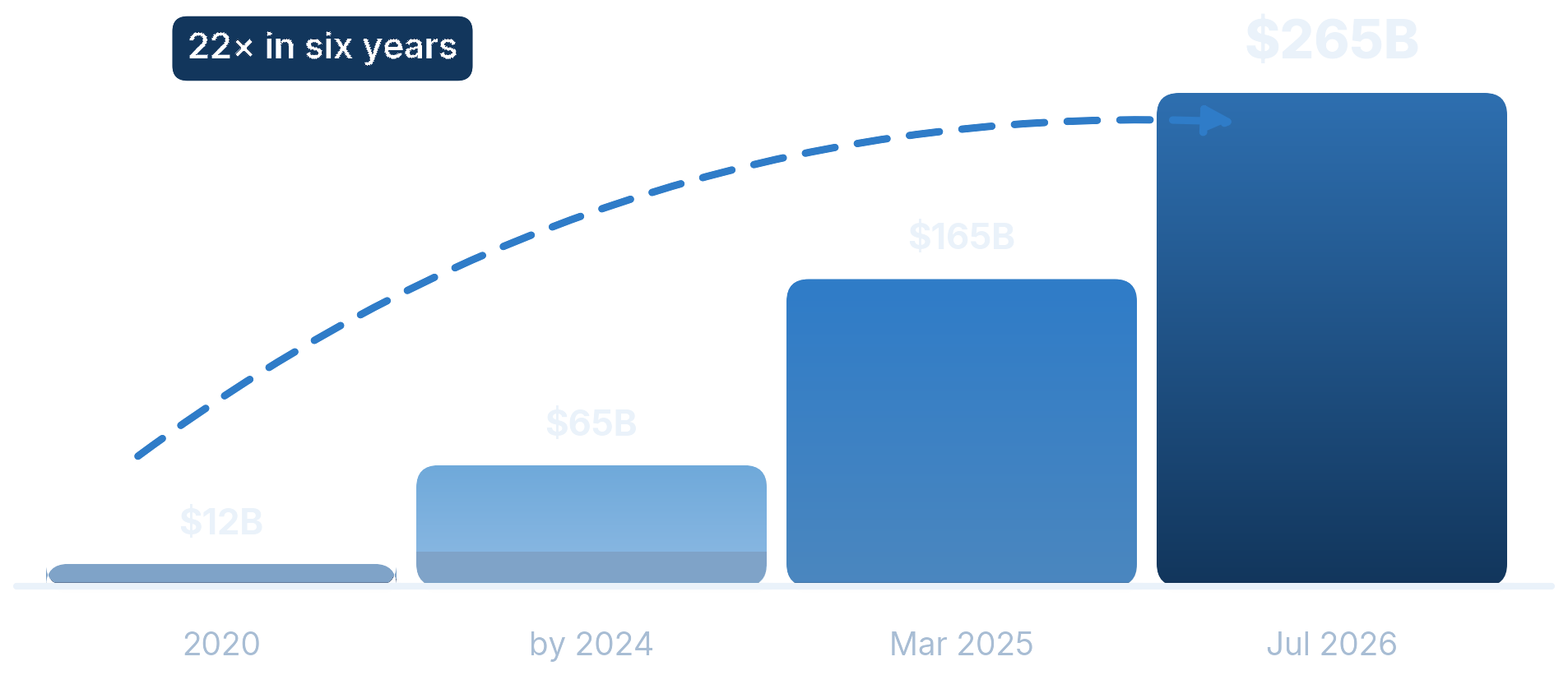
The staircase is the tell: this capital is not a press release, it is an escalation pattern. The buildings are certain. What runs them is not.
The labor gap is severe — and it is the problem capital is already addressing.
Brutal, yes. But this is exactly the kind of problem American capital knows how to attack — and in 2024, humanoids crossed from conference demo to payroll:
None of this implies fully automated factories by 2030. It does mean that, for the first time, the path to closing the labor gap is visible and funded.
Every robot deployed is another consumer of work instructions, schedules, quality specs, and exception handling. Absent a system directing what to make, when, and how to respond when an upstream station falters, a robot is stranded capital.
The newest machines on the floor take their orders from the oldest software in the plant.
Below the ERP line sits the stack that makes things: MES to track production, planning and scheduling engines to decide what runs where, SCADA and HMIs to supervise machines, historians to record what they did, quality and maintenance systems, and underneath it all, PLCs running the logic. The dates tell the story.
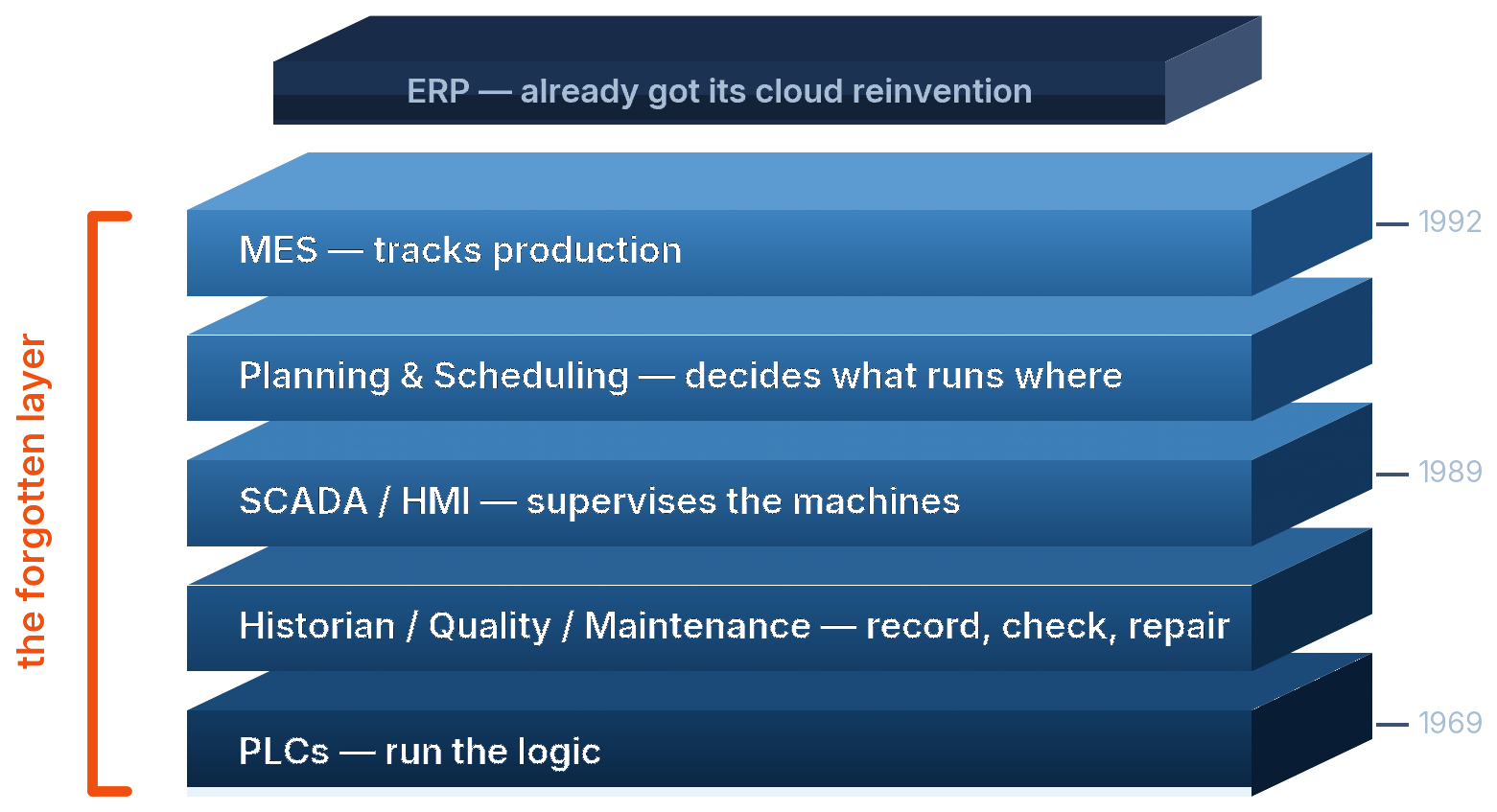
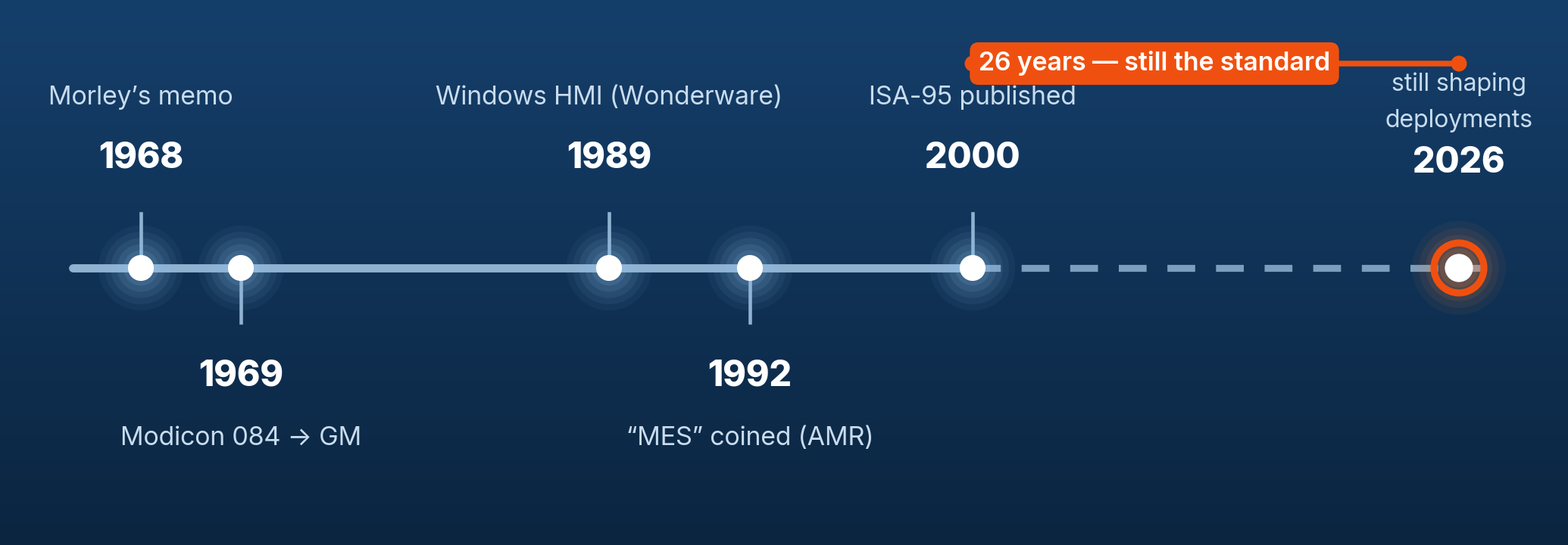
Ladder logic was deliberately drawn to resemble relay wiring diagrams so 1970s plant electricians could read it — and it still looks like that today. Early accounts put the downtime reduction in GM’s floor testing of the 084 near 60% versus the relays it replaced.8 Even the newer tools with strong practitioner followings are, for the most part, better-executed versions of the same ideas.
Three hundred vendors — and more than half the world’s factories still run on workarounds.
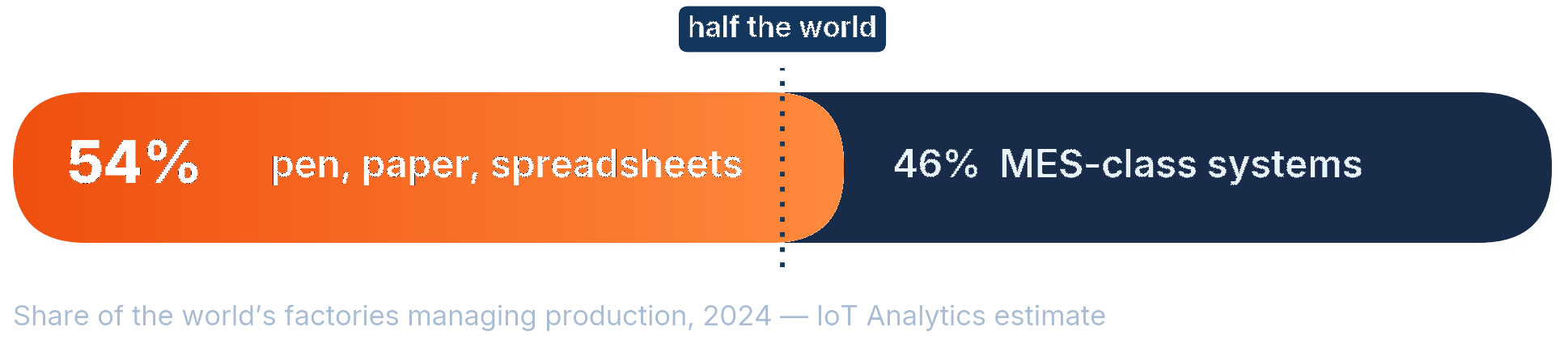
LNS Research traced it to the category’s earliest days: purpose-built closed systems, lopsided service-to-software ratios, and implementations that "seemed to have no end."14 Upgrades are deferred for years; no organization lightly touches the system that runs the plant. The closest thing manufacturing has to a universal system is therefore not Siemens’ or Rockwell’s — it is Excel.
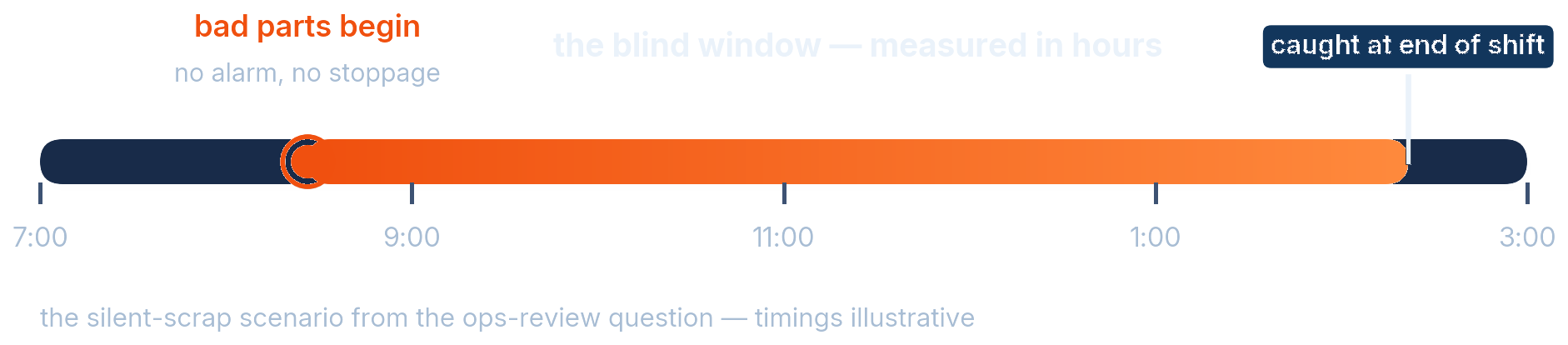
If the highest-margin line began producing scrap this moment — no alarm, no stoppage, simply bad parts — how long before anyone knew?
Posed candidly, the answers tend to come back in hours — sometimes a full shift. Downtime, the more visible counterpart of that silent loss, is well quantified: in ABB’s 2023 survey of 3,215 plant-maintenance decision-makers, 69% absorb an unplanned outage at least monthly — a dozen or more a year — at a typical cost near $125,000 an hour ($103,000 in the U.S.).15
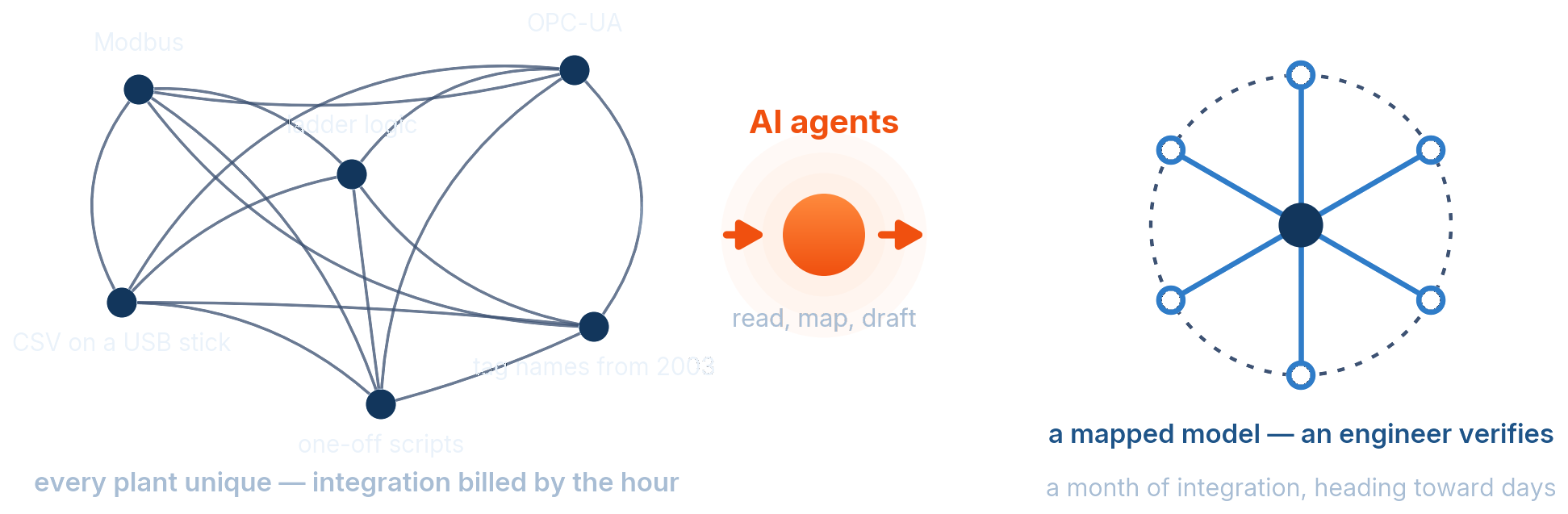
None of this reflects backwardness on the part of manufacturers; the structure worked against them. Every plant is an accumulation of its own history — a 1994 press brake next to a 2024 robot cell, Modbus next to OPC-UA next to a CSV on a USB stick. Integrating that heterogeneity was human labor billed by the hour, and much of the software business quietly became a services business: the innovator’s dilemma, applied to the plant floor. Sales received Salesforce, IT received ServiceNow, HR received Workday — and the factory floor too often received a copilot bolted onto a client-server application from 1998.
For operators, the economics are stark.
World-class benchmark per Nakajima’s TPM work; typical range and ~6% figure from Evocon’s installed-base data.18 Arithmetic: 85 ÷ 60 ≈ 1.42 — same machines, same people, same walls.
The skepticism is warranted. The difference now is two collapsing costs.
The industry watched the Industry 4.0 wave crest and break. GE spent six years and more than $4 billion on its digital push built around Predix; Jeff Immelt vowed GE would become a "top 10 software company" by 2020, and by 2017 Reuters was chronicling the retreat.16 A wave of IoT platforms stopped at connectivity and dashboards, leaving manufacturers to build the actual applications themselves — in plants that had no software teams to build them. And all of it was attempted a full decade before language models could read a PLC program.
Two costs have historically made factory software difficult to buy and deploy: the cost of integration and the cost of interface. AI agents are starting to collapse both — reading ladder logic, making sense of tag names written in 2003, drafting the mappings and adapters for an engineer to verify. When integration cost falls, per-site uniqueness falls with it, and with it the multi-year deployment. In this market, deployment time is the decisive variable.
Every generational vertical-software company was built on the same event: an architecture shift the incumbent could not cross. The supervisory software incumbents built was designed as systems of record, made to document what happened. What this moment demands are systems of action, designed to decide what happens next. Retrofitting agency onto a 1990s data model is how such transitions are lost. Siebel dominated CRM at the turn of the century, saw the cloud coming, launched its own on-demand product, and still sold to Oracle for $5.85 billion in 2005.17 The architecture would not let it cross.
One line serious builders do not cross: no language model belongs in the safety loop. Interlocks remain hard; safety-rated logic remains deterministic. Those standards exist because lives were lost establishing them. The agents belong above the control layer, in the supervisory space where people spend their days coordinating, diagnosing, planning, and firefighting.
The market, sized two ways
Before counting the far larger integrator-services pool that agents turn into product — and before counting the 54% of factories that never bought the last generation of software: greenfield for whoever wins this one.12
An urgent, well-funded buyer; incumbents constrained by their own installed base; a new architecture. The three converge in a market of this size roughly once a decade.
You cannot transform what you do not understand.
The instinctive conclusion is to remove the legacy systems and install something modern. That instinct is precisely what produced the industry’s multi-year deployments and its inventory of stalled implementations. Few organizations retain a complete, current picture of these systems. The engineers who configured them have retired. The documentation describes the system as it was scoped in 2009, not as it runs today. The most reliable remaining record is the systems themselves: their code, their configurations, their logs.
Axiarete was built for precisely this moment. It begins where the truth still lives — in the systems themselves — and turns that record into a living digital twin of the technology estate: every application, dependency, cost, and risk, illuminated and kept current as the estate changes. From that living picture the path is a single arc: understand the portfolio; optimize it — rationalize what sprawls, modernize what matters; operate it as a living system.
Every industrial leap has arrived the same way: when the connective layer caught up with the machines. Electrification rewired the steam-age plant; the assembly line rewired craft production. The systems layer is that connective layer now — and for the first time, it can be understood, optimized, and operated as one living whole.
None of it is handed over as a boxed product. AxiareteForge — services as software — is the delivery engine that walks the arc with the client: AI-augmented engineering, forward-deployed, with architects who scope against the graph and engineers who ship inside the client’s pipelines from week one. It is the embedded model Palantir established, applied to the systems that run production; each engagement strengthens the platform, and every estate read accelerates the next.
Understand. Optimize. Operate. Understanding takes the risk out of optimization; optimization gives operation something worth governing; operation feeds what it learns back into understanding. That arc — not any single capability — is what opens this market, because it addresses the two variables that have constrained it for three decades: deployment time and deployment risk. The estate stops being an archive of past decisions and becomes the nervous system of what happens next.
For operators who recognize their plants in this analysis, we welcome the conversation — we would rather demonstrate on your own estate than present slides. For those who build or invest in this domain, the pattern will be familiar: categories of this size open roughly once a decade, and they do not remain open long.
Prepared for operators and investors in American manufacturing · Axiarete AI
References
- Manufacturing construction spending, ~$82B (2021) to more than $230B (2024): U.S. Census Bureau, Total Construction Spending: Manufacturing, via FRED (TLMFGCONS) — fred.stlouisfed.org/series/TLMFGCONS
- TSMC $165B U.S. commitment (March 2025), described by TSMC as the largest single foreign direct investment in U.S. history; raised to $265B in July 2026: TSMC — pr.tsmc.com/english/news/3210 and tsmc.com/static/abouttsmcaz
- 481,000 open manufacturing jobs (June 2026, preliminary), up 23% year over year: U.S. Bureau of Labor Statistics, JOLTS release, Aug. 4, 2026 — bls.gov/jlt; manufacturing breakout as reported by Manufacturing Dive — manufacturingdive.com
- 3.8M workers needed 2024–2033; up to 1.9M unfilled: Deloitte & The Manufacturing Institute, "Taking Charge," April 2024 — deloitte.com
- 542,000 industrial robots installed in 2024 (2× a decade ago); ~4.7M in operation: International Federation of Robotics, World Robotics 2025 press materials (IFR newsroom) — ifr.org
- GXO × Agility humanoid deployment (Spanx facility, June 2024), described by the companies as the industry’s first commercial RaaS deployment: Agility Robotics — agilityrobotics.com
- Figure 02 at BMW Spartanburg: ~10 months, 90,000+ components, 30,000+ X3s, per BMW and Figure: as reported by The Robot Report — therobotreport.com
- Modicon 084 history: Morley’s Jan 1, 1968 memo; November 1969 delivery to GM: Control Engineering — controleng.com; ~60% downtime reduction vs. relays in GM testing, per early accounts: Engineering.com — engineering.com
- Wonderware pioneered Windows in industrial automation, 1989: Wonderware/Invensys via Automation.com — automation.com
- "MES" coined by AMR Research, 1992: Aptean — aptean.com; corroborated by LNS Research (ref 14)
- ISA-95 first published 2000 (ANSI/ISA-95.00.01-2000): ISA/Tulip overview — tulip.co
- 300+ MES vendors; 54% of factories on pen, paper, and spreadsheets (2024, IoT Analytics estimate); MES at $5.5B (software) inside an $85B industrial software market: IoT Analytics, MES Market Report 2025–2031 — iot-analytics.com
- 70% of manufacturers rely on manually entered data: NAM Manufacturing Leadership Council — manufacturingleadershipcouncil.com
- Early MES service-to-software ratios and endless implementations: LNS Research — blog.lnsresearch.com (modern TCO guides still put professional services at 2–3× license fees: Shoplogix — shoplogix.com)
- 69% of surveyed plant-maintenance decision-makers report unplanned outages at least monthly; typical cost near $125,000/hour globally, ~$103,000/hour U.S. (3,215 respondents): ABB, "Value of Reliability," 2023 — new.abb.com
- GE: six years and $4B+ on its Predix-centered digital push; "top 10 software company" pledge; 2017 retreat: Reuters, syndicated — foxbusiness.com
- Siebel: Oracle acquisition, $5.85B (2005): Oracle press release via SEC — sec.gov
- World-class OEE benchmark 85%; typical 55–60% and ~6% at benchmark within Evocon’s installed-base data across 50+ countries: Evocon — evocon.com (the 60→85 lift equating to ~40% more output is arithmetic: 85 ÷ 60 ≈ 1.42, all else equal)
- ~$1.4T/year in unplanned-downtime losses for the Fortune Global 500, ~11% of revenues (up from 8% in 2019); automotive downtime up to $2.3M/hour: Siemens/Senseye, The True Cost of Downtime 2024 (survey-based estimate, extrapolated), summarized by AEMT — theaemt.com (the six-hundred-dollars-a-second figure is arithmetic: $2.3M ÷ 3,600)
- MES market ~$16B (2025), ~10% CAGR, software and services: MarketsandMarkets — marketsandmarkets.com
- Large MES program timelines of 12–24 months (longer in regulated industries) and six-to-seven-figure budgets ($1–5M for mid-size deployments): Symestic — symestic.com; iFactory — ifactoryapp.com